You might have noticed I don't blog as much here as I used to. What I DO do is post a bit on our Cat's Meow Veterinary Clinic Facebook page.
I'm not retiring this blog. I really do plan to write more here at some point. But you know what they say about the road to hell being paved with good intentions!
Wednesday, January 20, 2016
Thursday, October 2, 2014
Veterinarians and Ebola Virus Disease (EVD)
You have probably heard in the news lately (unless you're Amish, or live off grid in Alaska) that there is a bit of an infectious disease problem in West Africa. And that this disease made an appearance in Dallas, Texas a couple of days ago in the person of one Thomas Eric Duncan.
What you might not have heard is that veterinarians know, or certainly should know, a great deal about Ebola Virus Disease (EVD) since this is yet another deadly zoonotic disease whose origins are probably in a number of African bat species.
Under the concept of One Health, it is the responsibility of both physicians and veterinarians to be cognizant of and preferably conversant in any diseases which can be spread from animals to humans or vice versa. It is also, or should be, our responsibility to reach out to clients in order to educate them about these diseases, particularly when they might affect our own community.
So here are some links to sound, factual scientific information about this disease. If you want the panicky rumor mill type stuff, you'll need to go to Alex Jones' horrifyingly irresponsible website or elsewhere on the intertubes.
CDC's Ebola page is pretty much the sine qua non of EVD resources.
WHO's web page is also good, but is more geared toward international public health considerations and not personal health.
Texas Department of State Health Services has limited information pertaining to this particular case, apparently in keeping with their beliefs in small government. This doesn't seem like it serves the interests of Texans very well, just between you and me.
The New York Times has an excellent Ebola page
NBC news has gathered all their Ebola coverage together in one place to make things easier.
As far as what I am doing or not doing, and thinking or not thinking about this new public health threat in the US - I have spent some time mulling over what steps I can personally take to ensure that, should EVD appear in SoCal, I am part of the solution and not part of the problem. So I am reading up on appropriate hygiene and how one applies that to the home, the workplace, and going out in public places. We might need to change our behavior and habits if it comes to that. I want to be ready.
.
What you might not have heard is that veterinarians know, or certainly should know, a great deal about Ebola Virus Disease (EVD) since this is yet another deadly zoonotic disease whose origins are probably in a number of African bat species.
Under the concept of One Health, it is the responsibility of both physicians and veterinarians to be cognizant of and preferably conversant in any diseases which can be spread from animals to humans or vice versa. It is also, or should be, our responsibility to reach out to clients in order to educate them about these diseases, particularly when they might affect our own community.
So here are some links to sound, factual scientific information about this disease. If you want the panicky rumor mill type stuff, you'll need to go to Alex Jones' horrifyingly irresponsible website or elsewhere on the intertubes.
CDC's Ebola page is pretty much the sine qua non of EVD resources.
WHO's web page is also good, but is more geared toward international public health considerations and not personal health.
Texas Department of State Health Services has limited information pertaining to this particular case, apparently in keeping with their beliefs in small government. This doesn't seem like it serves the interests of Texans very well, just between you and me.
The New York Times has an excellent Ebola page
NBC news has gathered all their Ebola coverage together in one place to make things easier.
As far as what I am doing or not doing, and thinking or not thinking about this new public health threat in the US - I have spent some time mulling over what steps I can personally take to ensure that, should EVD appear in SoCal, I am part of the solution and not part of the problem. So I am reading up on appropriate hygiene and how one applies that to the home, the workplace, and going out in public places. We might need to change our behavior and habits if it comes to that. I want to be ready.
.

Sunday, July 27, 2014
Why We Are Phasing Out Use of "Antibacterial" Handsoaps
Here at Cat's Meow Veterinary Clinic we have always used (and will continue to use) surgical scrub soap containing chlorhexidine for use on patients and prior to gloving up for surgery. But our everyday handsoap for use at sinks throughout the hospital is another matter.
Some years back I made the decision to switch to "antibacterial" handsoap containing triclosan because, well everyone was doing so and it seemed to make sense. But the devil is in the details. In the ensuing years there have been disturbing reports of environmental persistence by this chemical (yeah, we REALLY need another DDT, don't we?), and more frighteningly, its negative effects on soil and water microbes.
Now there are plenty of microbes we want to have a negative effect on: specifically the potential pathogens found on dirty hands. But the last thing I'd ever want to see is for those effects to spread beyond my hands and into our waterways and outdoor ecosystems. And that is exactly what is happening.
In 2011 Tufts University produced a white paper evaluating triclosan. They expressed concerns about bioaccumulation in fatty tissues of animals including humans, contributions to antibiotic resistance, and environmental effects.
I decided, based on these concerns, that it would be wise to end our use of products containing triclosan wherever possible. So we've been gradually using up the jug of Dial Antibacterial Handsoap we had on hand (I felt this was preferable to sending it en masse to a landfill - dilution is the solution to pollution in this case) - and I am happy to report that we are now down to the final 8 ounces or so in the final dispenser.
Research studies have shown that vigorous handwashing with ordinary soap removes just as many bacteria as soaps containing triclosan, with far less environmental impact. It's all about mechanical removal, it turns out, and not about "sterilization" of hands (which is physically impossible anyway).
So I'm about to do a little happy dance as the last of that nasty orange stuff goes away. I now use a handsoap with no dyes, though it does have some fragrance. And as soon as I can find a jug of fragrance and dye-free handsoap, I will phase that in. I believe I spotted one at Whole Paycheck, but avoiding those pesky unintended consequences is well worth the cost.
Some years back I made the decision to switch to "antibacterial" handsoap containing triclosan because, well everyone was doing so and it seemed to make sense. But the devil is in the details. In the ensuing years there have been disturbing reports of environmental persistence by this chemical (yeah, we REALLY need another DDT, don't we?), and more frighteningly, its negative effects on soil and water microbes.
Now there are plenty of microbes we want to have a negative effect on: specifically the potential pathogens found on dirty hands. But the last thing I'd ever want to see is for those effects to spread beyond my hands and into our waterways and outdoor ecosystems. And that is exactly what is happening.
In 2011 Tufts University produced a white paper evaluating triclosan. They expressed concerns about bioaccumulation in fatty tissues of animals including humans, contributions to antibiotic resistance, and environmental effects.
I decided, based on these concerns, that it would be wise to end our use of products containing triclosan wherever possible. So we've been gradually using up the jug of Dial Antibacterial Handsoap we had on hand (I felt this was preferable to sending it en masse to a landfill - dilution is the solution to pollution in this case) - and I am happy to report that we are now down to the final 8 ounces or so in the final dispenser.
Research studies have shown that vigorous handwashing with ordinary soap removes just as many bacteria as soaps containing triclosan, with far less environmental impact. It's all about mechanical removal, it turns out, and not about "sterilization" of hands (which is physically impossible anyway).
So I'm about to do a little happy dance as the last of that nasty orange stuff goes away. I now use a handsoap with no dyes, though it does have some fragrance. And as soon as I can find a jug of fragrance and dye-free handsoap, I will phase that in. I believe I spotted one at Whole Paycheck, but avoiding those pesky unintended consequences is well worth the cost.
Saturday, July 12, 2014
Updated Information on the Rabid Skunk in Long Beach
We just got this press release from the Long Beach Health Department. I am relieved that it was NOT the skunk variant, which would have been an ominous development with serious public health implications, particularly for our local feral cat population.
July 3, 2014
July 3, 2014
Contact: Mitchell Kushner, MD, City Health Officer, 562.570.4047
For immediate release
First rabid skunk to test positive in Los Angeles County
since 1979 confirmed to be rabies variant carried by bats
The California Department of Public Health confirmed today that the rabid skunk found last week in Long Beach was infected with a rabies virus variant from the Mexican-free-tailed bat. While bats in the area have tested positive for rabies in past years, this was the first confirmed case of rabies in a skunk in Los Angeles County since 1979. Mexican-free-tailed bats are very common in Southern California, and are the species of bats that most commonly carry rabies in the state.
Bat-to-mammal transmission is not uncommon, and the rabid skunk likely had an encounter with a bat infected with rabies. “This is the time of year that we might see more bat rabies, and potentially spillover to terrestrial mammals,” said City Health Officer Dr. Mitchell Kushner. “We do not anticipate that this spillover event is anything more than an isolated incident.”
The testing was important to determine that a skunk variant of rabies, which is only noted in Northern California, has not be re-introduced to Southern California where it has not been seen since 1979.
Continued vigilance in testing wildlife that is ill or exhibiting unusual behavior is still recommended. Anyone noticing obviously ill wildlife or unusual symptoms by animals should contact Animal Care Services at 562-570-7387. The Health Department and staff from Animal Care Services remind residents that they should not try to capture or trap wildlife, and that all domestic pets should receive their scheduled rabies vaccine to prevent pets and humans from getting rabies from other animals.
For more information on rabies, call Long Beach Animal Care Services at 562-570-7387.
# # #
Tuesday, July 8, 2014
Preventive Care for Kittens
It's been quite a while since I wrote the previous edition of my kitten prevention recommendations, and I can't find the post easily, so I think it's time to write an updated version.
Kittens should be seen promptly when first acquired (within a day or two) to assess their age and look for any urgent problems, in addition to coming up with a game plan for vaccinations, parasite control, diagnostic testing, and neutering. Generally this first visit is at about 8 weeks, but in younger kittens it can be much earlier. We do recommend that, whenever possible, kittens stay with their mom and litter mates until 8 weeks to allow the greatest chance of normal psychological and behavioral development.
At 8 weeks:
FVRCP-C #1 - first in series of three distemper/upper respiratory preventive vaccinations
Parasite control - flea control and internal parasite treatment as indicated - typically we administer an oral dewormer and outline what external parasite control you should be using, depending on individual circumstances.
Basic physical examination - eyes, ears, skin, mouth, heart/lungs, abdominal palpation
Q&A - be sure to come with a list of questions to ask the doctor because that's one of the most important parts of the visit
At 12 weeks:
FVRCP-C #2 - second in series
FeLV #1 - first in series of two feline leukemia preventive vaccinations
Parasite control - another oral deworming
Physical examination - just like the first time, but looking for normal weight gain and growth and development of any abnormalities or signs of illness
This is the earliest possible date to do FeLV/FIV testing, but obtaining a blood sample at this age is difficult so we usually defer it unless the kitten looks suspicious.
Q&A - ask away
At 16 weeks:
FVRCP-C #3 - final in the series (boosters annually or every three years depending on brand)
FeLV #2 - final in the series (boosters every 1 or 2 years depending on brand)
Rabies - not part of a series (booster in one year, then every 1 or 3 years depending on brand)
Physical examination - weighing again and looking over to make sure all appears normal
FeLV/FIV test if kitten cooperative.
Q&A - keep asking - we're here to answer
Neutering:
We recommend spaying females at 6 months of age and males at 8 months. Yes, it can physically be done earlier, but we feel that it is not in the cat's best long-term medical interests to jump the gun. It is rare for females to come into heat before even 5 months, and if she goes into heat it doesn't need to change our plans for surgery - it just costs a little more. We do NOT wait until she goes out of heat because that takes months and is unwarranted. Just be sure to keep her indoors 100% of the time until she has been spayed.
As for males, we especially do not want to do surgery prematurely as this has been associated with hip fractures in young males, and in our experience it also increases the risk of obesity and urinary obstruction down the road. It is quite rare for males to spray prior to 1 year of age, and if the stinky urine odor from hormones kicks in and bothers you too much, we can move the date up 2-4 weeks to keep you from going crazy.
We most commonly get our blood samples for FeLV and FIV testing at the time of spaying/neutering since the patient is 100% cooperative when anesthetized and we don't have to scare them to get it.
Down the road:
This isn't the end of medical care for kitty - it's just the start. All cats, regardless of lifestyle, breed, or owners' perception of risk, need to see a vet annually for an exam and vaccinations through age 8, and then twice a year after that, at a minimum. Once cats are mature, one calendar year ages them like four years in a human. These annual visits are a great way to discuss any concerns you have about ongoing minor concerns.
Kittens should be seen promptly when first acquired (within a day or two) to assess their age and look for any urgent problems, in addition to coming up with a game plan for vaccinations, parasite control, diagnostic testing, and neutering. Generally this first visit is at about 8 weeks, but in younger kittens it can be much earlier. We do recommend that, whenever possible, kittens stay with their mom and litter mates until 8 weeks to allow the greatest chance of normal psychological and behavioral development.
At 8 weeks:
FVRCP-C #1 - first in series of three distemper/upper respiratory preventive vaccinations
Parasite control - flea control and internal parasite treatment as indicated - typically we administer an oral dewormer and outline what external parasite control you should be using, depending on individual circumstances.
Basic physical examination - eyes, ears, skin, mouth, heart/lungs, abdominal palpation
Q&A - be sure to come with a list of questions to ask the doctor because that's one of the most important parts of the visit
At 12 weeks:
FVRCP-C #2 - second in series
FeLV #1 - first in series of two feline leukemia preventive vaccinations
Parasite control - another oral deworming
Physical examination - just like the first time, but looking for normal weight gain and growth and development of any abnormalities or signs of illness
This is the earliest possible date to do FeLV/FIV testing, but obtaining a blood sample at this age is difficult so we usually defer it unless the kitten looks suspicious.
Q&A - ask away
At 16 weeks:
FVRCP-C #3 - final in the series (boosters annually or every three years depending on brand)
FeLV #2 - final in the series (boosters every 1 or 2 years depending on brand)
Rabies - not part of a series (booster in one year, then every 1 or 3 years depending on brand)
Physical examination - weighing again and looking over to make sure all appears normal
FeLV/FIV test if kitten cooperative.
Q&A - keep asking - we're here to answer
Neutering:
We recommend spaying females at 6 months of age and males at 8 months. Yes, it can physically be done earlier, but we feel that it is not in the cat's best long-term medical interests to jump the gun. It is rare for females to come into heat before even 5 months, and if she goes into heat it doesn't need to change our plans for surgery - it just costs a little more. We do NOT wait until she goes out of heat because that takes months and is unwarranted. Just be sure to keep her indoors 100% of the time until she has been spayed.
As for males, we especially do not want to do surgery prematurely as this has been associated with hip fractures in young males, and in our experience it also increases the risk of obesity and urinary obstruction down the road. It is quite rare for males to spray prior to 1 year of age, and if the stinky urine odor from hormones kicks in and bothers you too much, we can move the date up 2-4 weeks to keep you from going crazy.
We most commonly get our blood samples for FeLV and FIV testing at the time of spaying/neutering since the patient is 100% cooperative when anesthetized and we don't have to scare them to get it.
Down the road:
This isn't the end of medical care for kitty - it's just the start. All cats, regardless of lifestyle, breed, or owners' perception of risk, need to see a vet annually for an exam and vaccinations through age 8, and then twice a year after that, at a minimum. Once cats are mature, one calendar year ages them like four years in a human. These annual visits are a great way to discuss any concerns you have about ongoing minor concerns.
Monday, November 4, 2013
CDC's New Guidelines for the Prevention and Treatment of Opportunistic Infections in HIV-Infected Adults and Adolescents
The CDC has come out with its new guidelines for HIV patients regarding prevention of zoonoses and opportunistic infections. It once again wisely advises patients to use meticulous hygiene around pets and emphasizes that there is no need to "get rid of the cat".
The guidelines just emphasize what we vets already know about basic handwashing and commonsense pet husbandry. HIV patients should of course avoid contact with cats less than 1 year old, cats or kittens with diarrhea, and cat feces in general. And cats should be on an appropriate external and internal parasite control regimen.
Sunday, August 11, 2013
I've Been A VERY BAD Blogger!
I know I haven't been blogging here. I'm sorry. I'm a BAD person.
I've been posting on Facebook, however, and I just started working on the side as a Cat Veterinary Expert over at Pearl.com. If you have cat health questions, you can ask me them over at this link:
http://www.justanswer.com/veterinary/expert-calcatdoc/
No, it's not free. But it's certainly not expensive, either. I cannot diagnose your cat or prescribe medications, but it is a very useful format for having your cat health questions answered. I look forward to hearing from you!
If you live locally, of course, I'd especially love to see you as a real life client at my brick-and-mortar cat hospital, Cat's Meow Veterinary Clinic. You can call us 8-6 M-F and 8-1 Sat to set up an appointment for me to see your cat(s).
Here's a question box, but it doesn't go directly to me - you can ask any pet question here:

I've been posting on Facebook, however, and I just started working on the side as a Cat Veterinary Expert over at Pearl.com. If you have cat health questions, you can ask me them over at this link:
http://www.justanswer.com/veterinary/expert-calcatdoc/
No, it's not free. But it's certainly not expensive, either. I cannot diagnose your cat or prescribe medications, but it is a very useful format for having your cat health questions answered. I look forward to hearing from you!
If you live locally, of course, I'd especially love to see you as a real life client at my brick-and-mortar cat hospital, Cat's Meow Veterinary Clinic. You can call us 8-6 M-F and 8-1 Sat to set up an appointment for me to see your cat(s).
Here's a question box, but it doesn't go directly to me - you can ask any pet question here:
Monday, March 11, 2013
Cats With Fight Wounds
Spring and summer are the seasonal breeding period for cats, so this is when the toms are out and about, looking for trouble and creating it where there's a lack. They will typically beat up on the spayed females and neutered males in the area, causing all manner of injuries.
We tend to see claw scratches on the face, and serious eye injuries can result. But claws do not deliver the most significant fight injuries - that honor goes to the teeth.
Cats have long, sharp, pointed fangs (canines in doctor-speak) which deliver small but deep puncture wounds. The fangs also do a great job of inoculating bacteria deep inside the wounds, which then seal up rapidly due to their small entry point. After a day or two of incubating, the bacterial population in the wound explodes, the cat's immune system throws a few million white blood cells into the mixture, and you've got a smelly, oozing mess full of pus.
Most people are more than happy to come running to Cat's Meow Veterinary Clinic at that point, which makes me a happy camper. I not only get to do surgery on an abscess that is enough to turn the strongest of stomachs, which is reward enough in itself - I also get paid to do my magic. In spite of their horrible appearance and nasty odor, bite wound abscesses are among the most rewarding and simple of conditions I am asked to treat.
The downside is this: abscess treatment easily runs $300-400, and can go higher depending on circumstances and if complications develop. It's not cheap, and in spite of pet medical insurance being available for decades, most clients still haven't jumped on board with the idea.
But it doesn't have to be like this. All bite wound abscesses begin with a bite wound. If clients were to bring their cats in within the first 6-8 hours of a fight and we had the chance to put it on prophylactic antibiotics, most of these would never develop into an abscess in the first place. And that's a whole lot less expensive.
So the next time you suspect or know that your cat has been in a fight, make an appointment for an immediate exam so we can assess the need for treatment before it ever gets icky.
We tend to see claw scratches on the face, and serious eye injuries can result. But claws do not deliver the most significant fight injuries - that honor goes to the teeth.
Cats have long, sharp, pointed fangs (canines in doctor-speak) which deliver small but deep puncture wounds. The fangs also do a great job of inoculating bacteria deep inside the wounds, which then seal up rapidly due to their small entry point. After a day or two of incubating, the bacterial population in the wound explodes, the cat's immune system throws a few million white blood cells into the mixture, and you've got a smelly, oozing mess full of pus.
Most people are more than happy to come running to Cat's Meow Veterinary Clinic at that point, which makes me a happy camper. I not only get to do surgery on an abscess that is enough to turn the strongest of stomachs, which is reward enough in itself - I also get paid to do my magic. In spite of their horrible appearance and nasty odor, bite wound abscesses are among the most rewarding and simple of conditions I am asked to treat.
The downside is this: abscess treatment easily runs $300-400, and can go higher depending on circumstances and if complications develop. It's not cheap, and in spite of pet medical insurance being available for decades, most clients still haven't jumped on board with the idea.
But it doesn't have to be like this. All bite wound abscesses begin with a bite wound. If clients were to bring their cats in within the first 6-8 hours of a fight and we had the chance to put it on prophylactic antibiotics, most of these would never develop into an abscess in the first place. And that's a whole lot less expensive.
So the next time you suspect or know that your cat has been in a fight, make an appointment for an immediate exam so we can assess the need for treatment before it ever gets icky.
Friday, March 8, 2013
A Sick, Elderly Cat
Well, I feel terrible about not blogging for a while. I don't have an excuse other than that I spend too much time on Facebook - to my credit, this time is often spent sharing fascinating (and not-so-fascinating) web articles about various aspects of cats and cat health. Ok, I confess: Grumpy Cat, Simon's Cat, and Henri pics and videos, too.
Meanwhile, back at the clinic (oh yeah, I have doctor responsibilities), we had an interesting case today. Little old Charlotte, an elderly female domestic medium-hair who a loyal longstanding client of mine adopted a couple of years ago. came in with a complaint of eating ravenously but losing weight, accompanied by chronic vomiting. On exam my most remarkable finding was a heart rate of 280.
Lest you be trying to faint on me, you should be aware that 280 beats per minute is not the highest heart rate I've ever observed in a cat - that honor goes to the elderly Siamese nearly 20 years ago who topped out at around 320. But 280 is bad enough.
This particular set of symptoms, along with the cat's age (16 years or more), makes me highly suspicious of hyperthyroidism. Feline hyperthyroidism is not rare in older cats, and is fatal if untreated. I proposed a diagnostic workup along the lines of a blood panel and complete urinalysis including culture and sensitivity if indicated. We also cleaned the cat's teeth, which were still remarkably solid in spite of a heavy accumulation of calculus (yes, I know that I am always calling it "tartar" in casual conversation, but the correct term is calculus - so sue me).
This particular client has fallen on hard times lately, but he has a long track record with us and always tries to do as much as he can for his kitties. When he leaned toward declining the dentistry and urinalysis due to cost, I took the opportunity to offer covering whatever he couldn't with funds in our Cat's Meow Veterinary Clinic Charitable Fund. So Charlotte got the whole shebang, and her owner won't wind up on the street.
We created our charitable fund with this sort of situation in mind, along with using it to help the occasional homeless or about-to-become-homeless-and-needs-fostering cat - we've had more than a few of the latter come through here over the years. We accept donations in any amount - you can add a small amount to your bill when you check out, or you can just come in and donate, or mail us a check. We are always looking for suckers aka kind, generous cat lovers to pitch in and help the cause.
Meanwhile, back at the clinic (oh yeah, I have doctor responsibilities), we had an interesting case today. Little old Charlotte, an elderly female domestic medium-hair who a loyal longstanding client of mine adopted a couple of years ago. came in with a complaint of eating ravenously but losing weight, accompanied by chronic vomiting. On exam my most remarkable finding was a heart rate of 280.
Lest you be trying to faint on me, you should be aware that 280 beats per minute is not the highest heart rate I've ever observed in a cat - that honor goes to the elderly Siamese nearly 20 years ago who topped out at around 320. But 280 is bad enough.
This particular set of symptoms, along with the cat's age (16 years or more), makes me highly suspicious of hyperthyroidism. Feline hyperthyroidism is not rare in older cats, and is fatal if untreated. I proposed a diagnostic workup along the lines of a blood panel and complete urinalysis including culture and sensitivity if indicated. We also cleaned the cat's teeth, which were still remarkably solid in spite of a heavy accumulation of calculus (yes, I know that I am always calling it "tartar" in casual conversation, but the correct term is calculus - so sue me).
This particular client has fallen on hard times lately, but he has a long track record with us and always tries to do as much as he can for his kitties. When he leaned toward declining the dentistry and urinalysis due to cost, I took the opportunity to offer covering whatever he couldn't with funds in our Cat's Meow Veterinary Clinic Charitable Fund. So Charlotte got the whole shebang, and her owner won't wind up on the street.
We created our charitable fund with this sort of situation in mind, along with using it to help the occasional homeless or about-to-become-homeless-and-needs-fostering cat - we've had more than a few of the latter come through here over the years. We accept donations in any amount - you can add a small amount to your bill when you check out, or you can just come in and donate, or mail us a check. We are always looking for suckers aka kind, generous cat lovers to pitch in and help the cause.
Monday, January 7, 2013
Informative New Website About Fleas
I found a good website for everything you ever wanted to know about fleas - nice to have it all in one place.
In the interest of full disclosure - I've done some ghostwriting for the site. I'll stop feeling smug now!
In the interest of full disclosure - I've done some ghostwriting for the site. I'll stop feeling smug now!
Wednesday, December 19, 2012
Healthy Holiday Gifts for Your Pet
This excellent article is from the AVMA and I couldn't agree more with it. Give the gift of good health to your furry family members - an annual checkup, vaccinations, and purchasing pet health insurance could make the difference between premature tragedy and a long, healthy life.
Saturday, November 10, 2012
Goldie is available for adoption!
Goldie, the little girl cat found out behind the clinic a couple of weeks ago, is available to a good forever home. She is a DSH orange tabby about 3 years old, spayed, and very friendly and affectionate. I think she'd be fine with another cat - she is curious about Cleo (who is very rude to her).

I'd like her to be strictly indoors, of course.
If you are interested or know someone who is, give us a call at 818-346-7161.
Update: Goldie was placed in a perfect forever home in early December and is adjusting beautifully. She has 2 dogs to play with and 3 humans, one of whom is a developmentally disabled adult who just adores her!
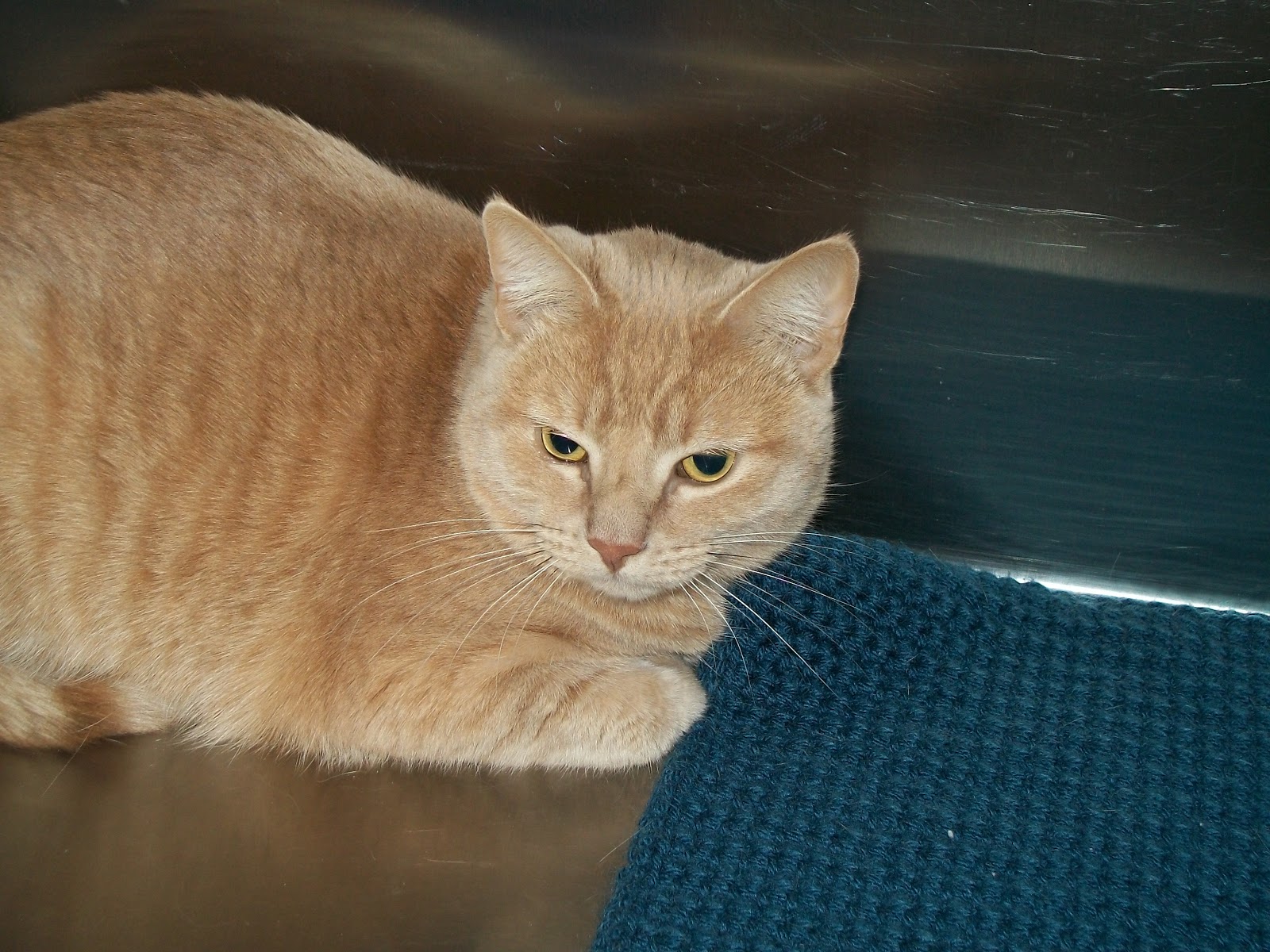
I'd like her to be strictly indoors, of course.
If you are interested or know someone who is, give us a call at 818-346-7161.
Update: Goldie was placed in a perfect forever home in early December and is adjusting beautifully. She has 2 dogs to play with and 3 humans, one of whom is a developmentally disabled adult who just adores her!
Wednesday, September 19, 2012
I've Been Published!
An essay I wrote recently has finally been published in Imprints, the new literary journal of the College of Veterinary Medicine and Biomedical Sciences at Colorado State University (my alma mater). All the contributors are faculty, staff, students, or alumni of the College. It consists mostly of photos and fine art (drawings, paintings, other visual arts), but there are some poems and 4 essays. Mine is the first. I have the right to publish it independently online or in print, so here it is (when an online link is available that shows the actual page image I will link to that - probably in October):
A PRAYER TO ARISTAIOS
A PRAYER TO ARISTAIOS
Thousands of years ago, in a place of
rocks and sea and cerulean skies, men and women gazed with terror upon the face
of evil: wolves and dogs and men seemingly made mad by the gods. The Greeks
called on Artemis, beseeching her to intervene against the illness known as
rabies as she was said to do. But Artemis always had better things to do than
listen to their pleas – not a single biting, shrieking, drooling victim lived
to tell of her power in all the long centuries of pleas. And their true foe, a
microscopic machine which exists only to make more copies of itself, worked
unseen and uncomprehended until one man deduced a means to fend off this
hideous destroyer of the mind.
We reap the benefits of Louis Pasteur’s
work even now. This French scientist brought us not only vaccines to prevent
rabies infection outright, but developed post-exposure prophylaxis, and all
without ever seeing his enemy. The ancient Greeks had another god, one who
guarded against the onset of the spreading madness: Aristaios; and they might
consider Pasteur to be his specially favored son.
Rather than blaming this disease on
angry gods, in recent centuries man has rewritten the myth in various literary
horror themes. Werewolves, vampires, zombies, alien invaders – on cursory
inspection these are stories with Freudian or Victorian themes, or merely
moneymaking fantasies which owe their proliferation to the availability of
cheap pulp paper for dime store novels, and later on the blossoming film
industry. But they all derive from a single fear unique to humans: the utter
obliteration of self, transmissible to others.
As a lifelong fan of the horror genre, I
find the zombie myth to come the closest to the reality of rabies. This has
perhaps been aided by my up close and personal encounter with this ancient
scourge fairly early in my career. A cat - every muscle finely trembling - grasping
blindly at the air just beyond its carrier door – pupils dilated as in death –
a single drop of saliva poised on lower lip. It had ceased to be a cat and been
instead transformed into an automaton with only one purpose: that of
transforming all other living creatures within reach into identical violent
automatons. Given the opportunity it would have shredded everyone in the exam
room into ragged, bloody walking dead.
My immediate and visceral reaction upon
seeing this poor doomed creature felt more like instinct than objective medical
evaluation. I knew that I was in the presence of Death. It may be that we as a
species have lived and evolved in proximity to this particular lyssavirus for
millions of years and in so doing can recognize and fear its handiwork almost
as readily as we do the hissing of snakes.
One would expect that the prospect of
such a terrible disease would cause veterinarians everywhere to rise up as one
and shout from the rooftops about the need to immunize our domestic house pets
against rabies even today. Certainly many have done so, and we can attribute
the vanishing of canine rabies from the United States to successful public
health campaigns involving private practice veterinarians. But here in Southern
California I find myself and many of my colleagues doing battle against an
uninformed public and veterinarians who apparently consider rabies, common in
our local bat population, as mythical a threat these days as the aforementioned
zombie and friends. It is more common for a new client to tell me that their prior
veterinarian specifically told them to avoid rabies vaccination than for them
to be able to tell me their cat has even once received it.
So we who recognize the danger soldier
on – we, who serve as priestesses and priests of Aristaios. We perform the rituals
of unwrapping syringes and mixing diluent into lyophilized powders and
injecting them into our willing supplicants, and all that is lacking in our
endeavors are incense and chanting and long linen robes. With each injection we
offer up a silent prayer that our nostrums do their magic, and that the evil be
kept at bay for another year, and another, and yet another. And we teach – or
at least we try. We are the new Greeks.
###
Apologies for the double spacing. I can't seem to fix it.
Tuesday, September 11, 2012
Oops
I just realized I hadn't posted here in a while, and it's been MORE than a little while. But you can find Cat's Meow Veterinary Clinic over on Facebook where I like to post news links relevant to feline medicine.
In other news, LA County Veterinary Public Health issued a press release today regarding the major increase in bat rabies in the county this year. You can read about it here.
Here'e the text of the press release (please excuse the formatting problems - I can't seem to improve it):
For Immediate Release: September 10, 2012
Increase in rabid bats in LA County prompts health concerns Avoid contact with bats; keep your pets’ rabies vaccine up-to-date
LOS ANGELES – A record-high of 45 rabid bats have been confirmed in Los Angeles County this year. The Department of Public Health is reminding all residents to avoid touching any bats or wild animals. Previously, the highest number of rabid bats seen in the county was 38 in 2011. “The reason for the increase in rabid bats is unclear. Regardless, it is important that everyone understand the potential dangers posed to themselves and their pets as most of these rabid bats have been found in and around homes,” said Jonathan E. Fielding, MD, MPH, Director of Public Health and Health Officer. “Children and teens especially should avoid handling bats or other wildlife, even if their intentions are to nurse an injured or ill animal back to health. If a bat is found near a home, a school, or another area frequented by people or pets it must be reported to the local animal control agency so rabies testing of the bat can be arranged.”
Since the beginning of 2012, several individuals and pets in various parts of the county have encountered rabid bats in public areas, in their front or back yards, and, occasionally, inside their homes. It is unusual to see bats on the ground or flying during daylight hours as healthy bats tend to stay away from humans. Individuals exposed to any bat or wildlife should seek immediate medical attention. A bite from a bat can be difficult to see on the skin, or on a pet, as bats have very small, very sharp teeth. Infection with the rabies virus can ultimately cause disease in the brain and death. “Thankfully, we have very effective post-exposure treatment and vaccine, which means there has not been a locally-acquired case of human rabies in Los Angeles County in over 50 years. Exposure to rabies is not contagious; people cannot transmit rabies to other people unless they themselves are sick with rabies,” said Dr. Fielding.
On average there are usually only 10 positive rabid bats discovered per year. The majority of bats do not carry rabies and these animals play an important environmental role by feeding on insects and controlling insect populations. Bat colonies found in a home’s attic, a commercial building, or other non-living space are protected by federal law and can only be removed by humane exclusion (release), and not by extermination. For more information about bat exclusions, visit http://www.batcon.org/index.php/bats-a-people/bats-in-buildings.html.
To reduce your risk of rabies: Make sure all pets are up-to-date on their rabies vaccinations. Unvaccinated dogs and cats exposed to rabid bats may need to be euthanized or may need to undergo a six-month quarantine at the owner’s expense. If you think you have been bitten by a bat or other wild animal, immediately wash the bite area with soap and water, and contact your doctor or health care provider to determine if you need post-exposure treatment. If possible, safely contain the animal and - 1 - - 2 - contact the local animal control agency to arrange for rabies observation and quarantine of the animal or rabies testing. If you find a bat on the ground near your home or in an area frequented by people and pets, do not attempt to touch the bat or capture it with your hands. Cover it with a bucket or box, keep children and pets away from the animal, and contact the local animal control agency. If a bat found inside a home may have had access to pets or areas where people were sleeping, do not release it outside; if possible put a small box or container over it. Contact the local animal control agency. For more information about rabies and rabid bats, visit the department’s Veterinary Public Health webpage at http://publichealth.lacounty.gov/vet/rabiesmap2012.htm.
The Department of Public Health is committed to protecting and improving the health of the nearly 10 million residents of Los Angeles County. Through a variety of programs, community partnerships and services, Public Health oversees environmental health, disease control, and community and family health. Public Health comprises nearly 4,000 employees and has an annual budget exceeding $750 million. To learn more about Public Health and the work we do please visit http://www.publichealth.lacounty.gov, visit our YouTube channel at http://www.youtube.com/lapublichealth, find us on Facebook at http://www.facebook.com/lapublichealth, or follow us on Twitter: LAPublicHealth. # # #
In other news, LA County Veterinary Public Health issued a press release today regarding the major increase in bat rabies in the county this year. You can read about it here.
Here'e the text of the press release (please excuse the formatting problems - I can't seem to improve it):
For Immediate Release: September 10, 2012
Increase in rabid bats in LA County prompts health concerns Avoid contact with bats; keep your pets’ rabies vaccine up-to-date
LOS ANGELES – A record-high of 45 rabid bats have been confirmed in Los Angeles County this year. The Department of Public Health is reminding all residents to avoid touching any bats or wild animals. Previously, the highest number of rabid bats seen in the county was 38 in 2011. “The reason for the increase in rabid bats is unclear. Regardless, it is important that everyone understand the potential dangers posed to themselves and their pets as most of these rabid bats have been found in and around homes,” said Jonathan E. Fielding, MD, MPH, Director of Public Health and Health Officer. “Children and teens especially should avoid handling bats or other wildlife, even if their intentions are to nurse an injured or ill animal back to health. If a bat is found near a home, a school, or another area frequented by people or pets it must be reported to the local animal control agency so rabies testing of the bat can be arranged.”
Since the beginning of 2012, several individuals and pets in various parts of the county have encountered rabid bats in public areas, in their front or back yards, and, occasionally, inside their homes. It is unusual to see bats on the ground or flying during daylight hours as healthy bats tend to stay away from humans. Individuals exposed to any bat or wildlife should seek immediate medical attention. A bite from a bat can be difficult to see on the skin, or on a pet, as bats have very small, very sharp teeth. Infection with the rabies virus can ultimately cause disease in the brain and death. “Thankfully, we have very effective post-exposure treatment and vaccine, which means there has not been a locally-acquired case of human rabies in Los Angeles County in over 50 years. Exposure to rabies is not contagious; people cannot transmit rabies to other people unless they themselves are sick with rabies,” said Dr. Fielding.
On average there are usually only 10 positive rabid bats discovered per year. The majority of bats do not carry rabies and these animals play an important environmental role by feeding on insects and controlling insect populations. Bat colonies found in a home’s attic, a commercial building, or other non-living space are protected by federal law and can only be removed by humane exclusion (release), and not by extermination. For more information about bat exclusions, visit http://www.batcon.org/index.php/bats-a-people/bats-in-buildings.html.
To reduce your risk of rabies: Make sure all pets are up-to-date on their rabies vaccinations. Unvaccinated dogs and cats exposed to rabid bats may need to be euthanized or may need to undergo a six-month quarantine at the owner’s expense. If you think you have been bitten by a bat or other wild animal, immediately wash the bite area with soap and water, and contact your doctor or health care provider to determine if you need post-exposure treatment. If possible, safely contain the animal and - 1 - - 2 - contact the local animal control agency to arrange for rabies observation and quarantine of the animal or rabies testing. If you find a bat on the ground near your home or in an area frequented by people and pets, do not attempt to touch the bat or capture it with your hands. Cover it with a bucket or box, keep children and pets away from the animal, and contact the local animal control agency. If a bat found inside a home may have had access to pets or areas where people were sleeping, do not release it outside; if possible put a small box or container over it. Contact the local animal control agency. For more information about rabies and rabid bats, visit the department’s Veterinary Public Health webpage at http://publichealth.lacounty.gov/vet/rabiesmap2012.htm.
The Department of Public Health is committed to protecting and improving the health of the nearly 10 million residents of Los Angeles County. Through a variety of programs, community partnerships and services, Public Health oversees environmental health, disease control, and community and family health. Public Health comprises nearly 4,000 employees and has an annual budget exceeding $750 million. To learn more about Public Health and the work we do please visit http://www.publichealth.lacounty.gov, visit our YouTube channel at http://www.youtube.com/lapublichealth, find us on Facebook at http://www.facebook.com/lapublichealth, or follow us on Twitter: LAPublicHealth. # # #
Friday, June 22, 2012
Urgent Press Release From LA County Public Health Re Rabid Bat At Santa Fe Dam Recreational Area
The Los Angeles County Department of Public Health sent out the attached
press release today.
______________________________________________________________________________________________
For Immediate Release:
June 22, 2012
Persons who may have had contact with rabid bat sought: Bat found at
Santa Fe Dam Recreational Area in Irwindale
LOS ANGELES – County health officials are seeking help from the
community in locating anyone who may have touched or had contact with a
bat found at the Santa Fe Dam Recreational Area in Irwindale on
Saturday, June 9, 2012. The bat was found clinging to the side of a rock
column inside the snack area near the boat and bike rental concession. A
crowd of people, including children, were gathered around the bat for
about 30 minutes before park officials intervened. The bat was captured
and tested positive for rabies.
“It is very important that any individuals who touched or had contact
with this bat contact our department. We can help determine if you will
need to receive urgent rabies preventive treatment,” said Jonathan E.
Fielding, MD, MPH, Director of Public Health and Health Officer.
Individuals who touched or may have had contact with the bat found at
the Santa Fe Dam Recreational Area on June 9th should contact Public
Health’s Acute Communicable Disease Control unit at (213) 240-7941 for
evaluation.
Eleven rabid bats have been found in Los Angeles County so far this
year, suggesting that the disease is increasing in bats. Although the
vast majority of bats in nature do not have rabies, on average, about
eight to 12 rabid bats are detected per year. Public health officials
have not determined why there is an increase. Any contact with bats and
other wild animals should be avoided, as it is not always possible to
visually determine if an animal has rabies. A bite from a rabid animal
could cause rabies infection in people or other animals.
“Bat bites can be undetectable as they have very small, very sharp
teeth. No one should touch or handle bats found near or on the ground,
and children should be taught to avoid touching bats or other wild
animals,” said Dr. Fielding. “Make sure you maintain current rabies
vaccines for your pets as well. If a bat may have bitten a person or a
pet, contain the bat as safely as possible without touching it and
contact your local animal control department. Individuals or pets who
may have been bitten should seek immediate medical attention.”
The Department of Public Health is committed to protecting and
improving the health of the nearly 10 million residents of Los Angeles
County. Through a variety of programs, community partnerships and
services, Public Health oversees environmental health, disease control,
and community and family health. Public Health comprises nearly 4,000
employees and has an annual budget exceeding $750 million. To learn more
about Public Health and the work we do please visit
http://www.publichealth.lacounty.gov, visit our YouTube channel at
http://www.youtube.com/lapublichealth, find us on Facebook at
http://www.facebook.com/lapublichealth, or follow us on Twitter:
LAPublicHealth.
_______________________________________________________________________________
This press release may be shared freely. Please help us spread the word
about rabies and find those who might have had contact with the rabid
bat.
Additional information about local bat rabies, including maps showing
where they have been found, is posted on the Veterinary Public Health
website::
Program web site: http://publichealth.lacounty.gov/vet/index.htm
2012 Bat Rabies info:
http://publichealth.lacounty.gov/vet/rabiesmap2012.htm
Tuesday, June 5, 2012
Cleo
I wanted to give Miss Cleo Crankybutt, our newest mascot, her own special blog post including photos. She is settling into her role nicely, though she is obviously a one-person cat and I am that one person. She has little interest in meeting clients, and does not like other cats (hence the buspirone we give her).


 Sometimes she will come up to the front desk to see who is here, but her favorite place is either in my lap in the office, or on a box in the ward just around the corner from the office.
She was donated to us in February by an elderly gentleman who could no longer keep her.
Sometimes she will come up to the front desk to see who is here, but her favorite place is either in my lap in the office, or on a box in the ward just around the corner from the office.
She was donated to us in February by an elderly gentleman who could no longer keep her.


 Sometimes she will come up to the front desk to see who is here, but her favorite place is either in my lap in the office, or on a box in the ward just around the corner from the office.
She was donated to us in February by an elderly gentleman who could no longer keep her.
Sometimes she will come up to the front desk to see who is here, but her favorite place is either in my lap in the office, or on a box in the ward just around the corner from the office.
She was donated to us in February by an elderly gentleman who could no longer keep her.
Saturday, May 26, 2012
Keep Fluffy Away From That Medical Cannabis
Here's an excellent article from Boulder, CO (of course) about the hazards of marijuana in dogs and cats. This had sort of dropped off my radar, since I just do cats and they aren't often poisoned because of their discriminating taste buds, but young cats especially might be tempted to ingest the edible form.
I've only seen one patient in my career that got into trouble with cannabis - a young dog, probably over 25 years ago, was presented for lethargy and stumbling around. The owner was reluctant to talk about what had happened but eventually confessed to having left something tasty out where the dog found it. I assured him I wasn't going to call the police, and the dog didn't require hospital care.
These days, with so many people using medical cannabis the risk to pets is going to be higher. Be safe with your meds and keep them out of the reach of pets at all times, just like you would for children.
Memorial Day Weekend Hours
We will be open on Saturday May 26 until noon only. We will be closed Sunday like always, and Monday in observation of Memorial Day. Regular hours will resume on Tuesday.
Have a pleasant holiday weekend!
Wednesday, March 21, 2012
VERY big news day in the area of feline kidney disease!
Scientists in China have found a feline morbillivirus (that's the family of viruses that includes canine distemper and human measles) that appears to be connected to a significant percentage of kidney failure cases in cats. Because vaccines can be made easily for morbilliviruses, and they work REALLY well, this could be a huge breakthrough in the actual PREVENTION of this common cat disease.
For so many years we have had to shrug and admit we just don't know when people ask what causes so much kidney failure in cats. Some cases are due to a congenital genetic disorder, but most were always just a mystery.
I am really excited by this news and hope it turns out to be reproducible research, and most importantly that a vaccine is swiftly developed. I have lost too many patients and cats of my own to kidney failure.
For so many years we have had to shrug and admit we just don't know when people ask what causes so much kidney failure in cats. Some cases are due to a congenital genetic disorder, but most were always just a mystery.
I am really excited by this news and hope it turns out to be reproducible research, and most importantly that a vaccine is swiftly developed. I have lost too many patients and cats of my own to kidney failure.
Monday, March 5, 2012
Our phone appears to be out today.
No wonder it's not ringing. I am contacting Time Warner about it - my internet is fine. Hmmmm.
1:45 PM update: tech guy on the phone hasn't gotten back to me YET about the service tech's ETA. They can't fix it remotely. Sigh.
3:15 PM update: We have phones again. Phone modem died of old age (it was 18 months old). TWC needs to work on their hardware quality control.
Mar 12 update: Voicemail is out today, no way to leave us a message.
Mar 13 update: Voicemail restored. Time Warned Business Class unilaterally and without prior notice decided that I didn't HAVE voicemail. It took some very loud, angry discussion on my part to get them to accept that I had, in fact, had it for a year (since my account began). And that I am paying for it.
1:45 PM update: tech guy on the phone hasn't gotten back to me YET about the service tech's ETA. They can't fix it remotely. Sigh.
3:15 PM update: We have phones again. Phone modem died of old age (it was 18 months old). TWC needs to work on their hardware quality control.
Mar 12 update: Voicemail is out today, no way to leave us a message.
Mar 13 update: Voicemail restored. Time Warned Business Class unilaterally and without prior notice decided that I didn't HAVE voicemail. It took some very loud, angry discussion on my part to get them to accept that I had, in fact, had it for a year (since my account began). And that I am paying for it.
Subscribe to:
Posts (Atom)